So the eco-warriors and the bee-huggers got together for a protest in Parliament Square last Friday. The aim of the stunt was 'to grab the weekend headlines and pile the pressure on' ahead of an EU vote on banning neonicotinoids pesticides. The demo was called 'The March of the Beekeepers' which sounds impressive, except for one small detail; the British Beekeepers Association with it's 23,000 members wasn't involved! Clearly the green lobby is prepared to play fast and loose with the facts in it's ongoing war with the agro-chemical industry.
So why do UK beekeepers appear unconcerned - after all pesticides are wiping out the bees, right?
Well, actually we don't know because the available data are 'unable to demonstrate deleterious effects of neonicotinoids on honey bees managed by beekeepers in the UK.' Moreover, beekeepers are worried that an outright ban might encourage the use of older pesticides that are known to harm honey bees.
Of greater concern are bee diseases and habit degradation. You might have guessed - it's the ag-industry again, but this time it's trashing the environment with endless acres of monoculture ...except you'd be wrong.
Most beekeepers in the UK keep their hives in urban and suburban environments and the bees do very well thanks to gardens providing all-year-round forage. But with in-fill development we are rapidly destroying these habitats.
What to do - march on Parliament and ban builders? No, just grow better plants and trees for pollinators, don't trim the privet hedge when it's in bloom, and let the clover grow in your lawn rather than trying to kill it with herbicides; it will have far more benefit for bees than banning those pesticides.
Sunday, 28 April 2013

Thursday, 25 April 2013
Biggles learns to fly
New bees spend the first few weeks of their life doing various jobs inside the hive, but there comes a time when they have to learn to fly: Today was that day. Exactly 2 weeks after I saw evidence of new bees being born (see last post) the youngsters took to the skies.
It was a perfect day for flying, warm and not too windy, so at around 2 pm scores of bees poured out of the hive and started flying....backwards!
There's a reason for this - flying is easy but navigation is difficult. The bees fly backwards a few feet whilst looking at the hive. They then fly from side to side, and eventually into ever widening circles around the hive. All the time they are learning the landmarks that will help then find their way home.
By 3.30 pm these so called 'play flights' were extending 20-30 meters away from the hive and the bees were getting increasingly curious as their confidence built. All sorts of non-forage flowers were investigated and then ignored once they realised there was no useful nectar. All blocks of colour caught their attention - including me in a bright purple T-shirt. Needless to say I had to make a run for it when some bees got a bit too curious!
Tomorrow the playing stops. They will be getting instructions on useful sources of forage from the winter bees and the work begins. Perfect timing because the apple is just coming into blossom.
Sunday, 14 April 2013
New bees are fluffy
It takes exactly 3 weeks to make a honey bee. First there's an egg, which hatches into a tiny larva and quickly grows to become a fat white maggot. As if in disgust the bees then entomb the maggot in its cell by capping it over with wax. Slowly the maggot metamorphoses into a honey bee.
Watch carefully in the summer months and you will see the baby bees nibbling away at the wax capping covering their cells, before struggling to pull themselves out. Initially all the hairs on their body are sleeked down, but the nursery bees soon groom the new arrivals and within 10 minutes of emerging they look conspicuously fresh and fluffy, and ready to start work.
My colonies desperately need new workers. The winter bees are dying and they have to raise new bees otherwise the colonies are doomed. Until now there has been little sign of new life....until last Thursday.
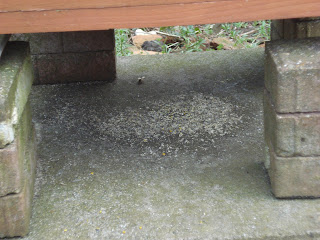
It happened between midday and 4 pm - a small pile of wax cappings appeared on the floor underneath the hive, as dozens of new bees emerged from their cells.
Of course, I couldn't be certain. It was still far too cold and wet to open up the hives, but today, 40 days after my shook swarms on 5th March, it was finally warm enough to take a look inside. To my delight therein were 3 frames with eggs, grubs and sealed brood, and a number of fluffy bees. This hive looks like it will survive.
Not so the other hive containing the neurotic bees. Yes, there was brood in all stages, but not much, and the cluster of bees is barely enough to occupy two seams. Their future looks bleak.
They say spring is 3 weeks late this year; just the length of time it would have taken to raise those new bees.
Watch carefully in the summer months and you will see the baby bees nibbling away at the wax capping covering their cells, before struggling to pull themselves out. Initially all the hairs on their body are sleeked down, but the nursery bees soon groom the new arrivals and within 10 minutes of emerging they look conspicuously fresh and fluffy, and ready to start work.
My colonies desperately need new workers. The winter bees are dying and they have to raise new bees otherwise the colonies are doomed. Until now there has been little sign of new life....until last Thursday.

It happened between midday and 4 pm - a small pile of wax cappings appeared on the floor underneath the hive, as dozens of new bees emerged from their cells.
Of course, I couldn't be certain. It was still far too cold and wet to open up the hives, but today, 40 days after my shook swarms on 5th March, it was finally warm enough to take a look inside. To my delight therein were 3 frames with eggs, grubs and sealed brood, and a number of fluffy bees. This hive looks like it will survive.
Not so the other hive containing the neurotic bees. Yes, there was brood in all stages, but not much, and the cluster of bees is barely enough to occupy two seams. Their future looks bleak.
They say spring is 3 weeks late this year; just the length of time it would have taken to raise those new bees.
Thursday, 4 April 2013
Mortuary Bees
'Bring out your dead' - It's a dirty job, but someone's got to do it!
Usually bees leave the hive to die, but every now and then they pop their clogs on the inside, especially during the winter months. As the days go by dead bees accumulate on the hive floor and over time these would block the hive entrance.
Fortunately, some workers are tasked with being mortuary bees. These bees collect the dead and drag them out of the hive. During the summer months it's not unusual to see mortuary bees flying like mini Chinook helicopters with their cargo slung beneath them, before unceremoniously dropping the corpses several metres away from the hive.
For winter bees the mortuary task is much harder. To start with winter bees are heavier (see Fat Girls) making airlifting impossible, but the real issue is that by now the bees are old and tired.
So they struggle to drag the dead from the hive, and onto the ground, and through the grass for a few feet before returning exhausted to collect the next casualty.
It's been unseasonable cold for well over a month, and on those rare occasions the bees have been able to fly, the mortuary bees have been busy - as I look around the hives I can see hundreds of dead bees.
It's a worry; the bees have plenty of sugar syrup so they won't starve, but they desperately need the protein in fresh pollen to raise brood.
For without new bees who will dispose of the dead?
Thursday, 28 March 2013
Workers' Wages
I'm concerned that my bees may be planning to take industrial action.
It was a broadcast last Tuesday morning on BBC Radio 4 - 'On the trail of the American Honey Bee' that got the hives buzzing. Apparently American bees get paid!
Not much admittedly, just 1 cent a month, but with 60,000 bees in each hive in the summer time that means I'm facing a potential wages bill of $1,200 a month. I'm ruined; just to cover the workers' wages I would have to charge £380 for a jar of honey.
Why do American bees get so well paid? Simple - they pollinate the most valuable crop on earth worth $2.5 billion p.a. - almonds. With 1.5 million hives being trucked into California each spring it's clear that pollination services provided by honey bees is big business.
We don't have almonds in the UK, or oranges or cranberries, but our bees still provide a great service pollinating apple, pear and plum trees; oil seed rape, raspberries, blackberries, field beans, runner beans and dozens of garden and wild flowers.
Most hobbyist beekeepers don't charge for pollination, but if my bees demand fair payment for services rendered, I'm going to be knocking on my neighbours doors and presenting an invoice!
Saturday, 16 March 2013
Fat Girls
Summer bees work so hard that they only live about 3 -4 weeks before they die. In contrast, winter bees live 4-5 months and spend most of their time mooching around the hive eating, and trying to stay warm. Not surprising, winter bees are a bit tubby.
To be fair this is more about genetic traits rather than life style choices - winter bees need to lay down fat deposits for survival, which is all well and good until some hapless beekeeper uses a queen excluder.
I had placed the queen excluder at the bottom of the hive to stop the queen rolling out or wandering off when I did that shook swarm. The queen is considerably bigger than the worker bees so she can't get through the wire mesh of the excluder. Neither can the fat girls as I found out last Thursday when there was a break in the weather.
Initially all looked encouraging; the bees were flying so they had clearly survived the cold snap. It was still too cold to take a look inside the hive, so all I wanted to do was check they had enough sugar syrup (they did) and remove the queen excluder.
That's when I realised that winter bees really are well padded, because there, trapped in the mesh were about 20 - 30 bees. It wasn't a disaster, but I was annoyed. Every dead bee means a smaller cluster which means its harder to stay warm.
Sunday, 10 March 2013
Shook Swarm
I'm worried.
Last week when it was warm I decided to shake all of my bees out of their damp mouldy hives into clean dry hives using a technique called a 'shook swarm'. This involves taking each frame out of the old hive out and shaking off any bees into a new hive. It's absolutely essential to ensure you don't lose the queen, so I put a queen excluder underneath each hive to make sure she didn't roll out of the bottom!
Needless to say, bees don't like being thrown around like this, but mine were very good natured and within half an hour they were settled down and happily feeding on the sugar syrup I'd given them. I don't usually feed my bees sugar but all their honey and a few frames of brood were left behind in the old hives so unless I fed them they would starve.
It might seem brutal to remove the bees from their food and brood, but that brood contains varroa mite and those old frames might harbour bee diseases such as nosema. Although the manoeuvre will set the bees back a week or two, colonies purged of disease usually come back very strongly.
So why am I worried? Well more experienced beekeepers tell me it's too early in the season for such drastic measures. Initially I discounted their opinions because doing a 'shook swarm' in springtime is a relatively new technique that most of the 'old hands' have never used. But then it turned cold, and the forecast is for snow....
This cold snap is forecast to last for another 72 hours so I will have to wait until Thursday at the earliest to see if my bees have survived.
Subscribe to:
Posts (Atom)